Try the agent
Codex-style access helps people ask for code, docs, reviews, and project ideas from a familiar AI surface.
OpenAI Codex Mobile Workflow
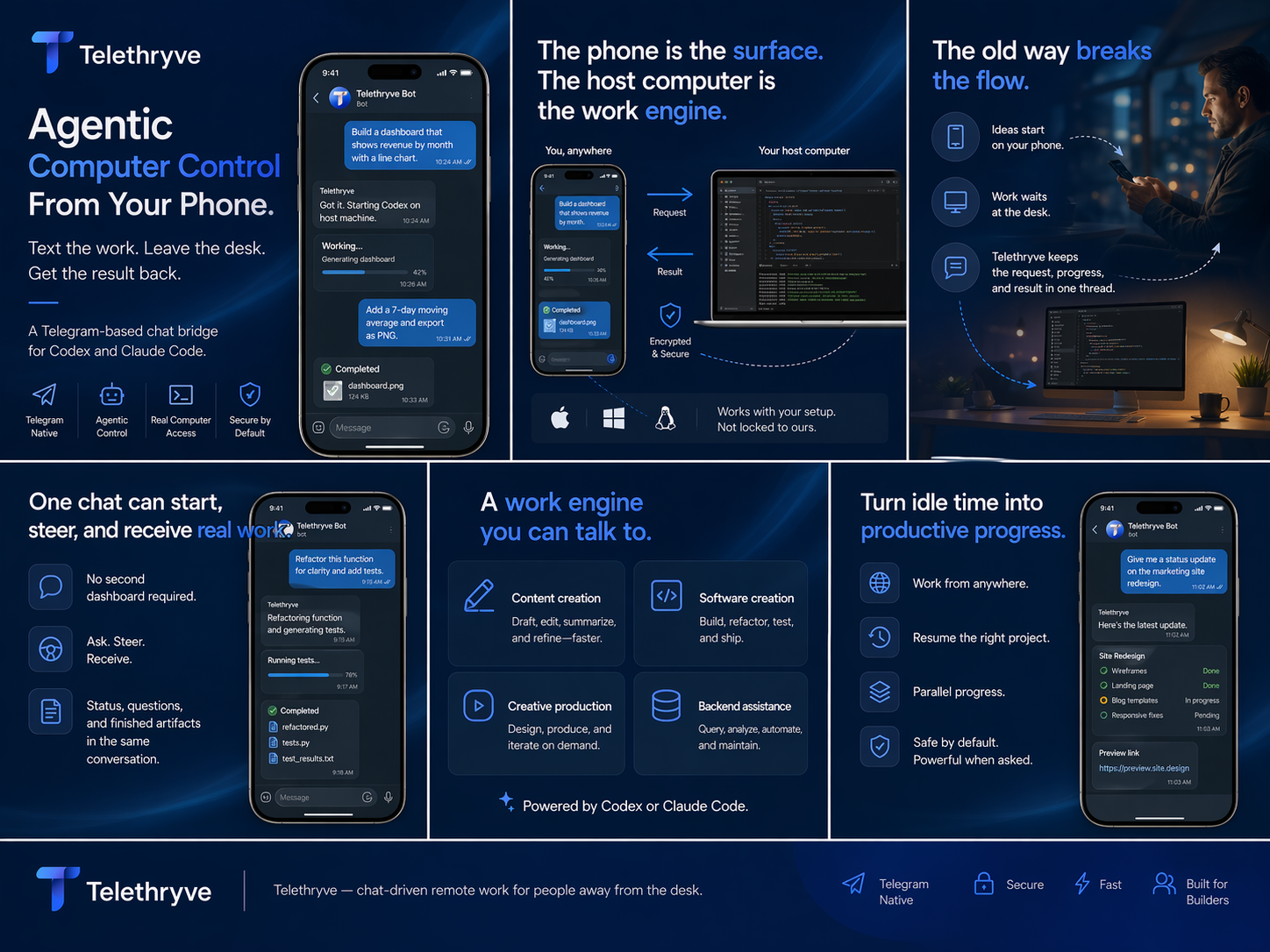
Telethryve Desktop supports Codex-style project work on the workstation. Optional mobile access can help a phone request become agentic coding, review, docs, tests, or release chores; see /apps/ for availability and terms.
Designed for real workstation work
Agentic coding is strongest inside the project environment. Telethryve lets the phone initiate that work without pretending the phone should hold the full developer setup.
Value Against Free
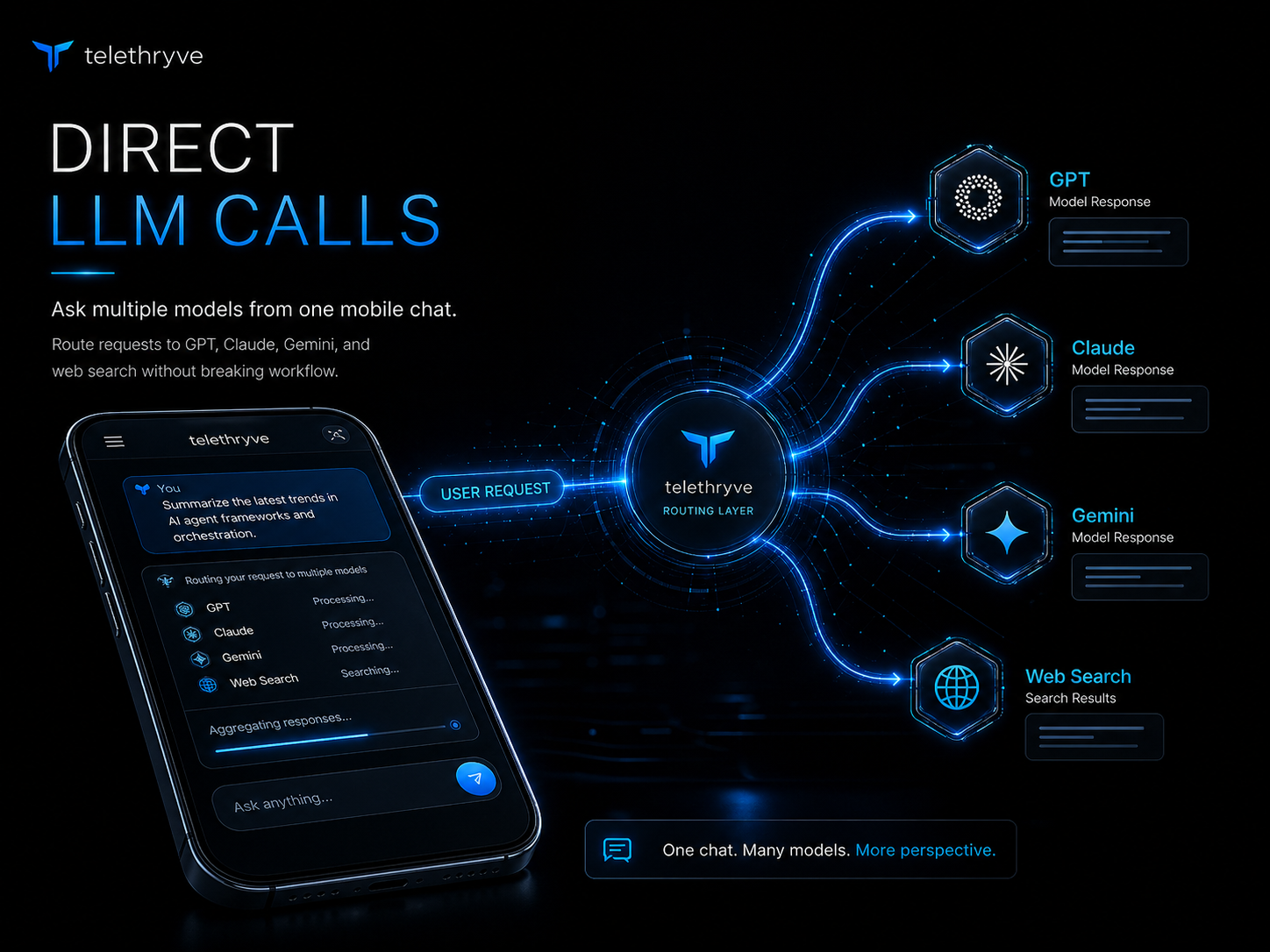
Do not pay Telethryve for another AI brain. Pay when the useful part is starting, steering, resuming, and receiving real work on the workstation that already has the project context.
Codex-style access helps people ask for code, docs, reviews, and project ideas from a familiar AI surface.
Telethryve Desktop connects configured AI to the machine with the repo, files, tools, coding apps, local context, and output path.
Phone availability and current access terms are listed on the Apps page.
Why Telethryve
Telethryve should be bought only when mobile command, project continuity, local context, and real outputs matter.
Start from a mobile note while the task is fresh.
Route the request to the workstation profile that can use the right project context and tools.
Keep questions, status, and results visible so the human stays in control.
Use Case
Agentic coding is strongest inside the project environment. Telethryve lets the phone initiate that work without pretending the phone should hold the full developer setup.
Engineering founders, solo builders, product teams, support engineers, and anyone who needs small software chores to start before they get back to the desk.
FAQ
No. Telethryve is its own mobile command layer for workstation workflows that can include Codex-style agents when configured.
Use free or included Codex access when chat is enough. Use Telethryve when the request should become workstation work with local context, continuity, and returned artifacts.
Related Workflows
Telethryve turns a phone into the command surface for a real local AI workstation, so files, tools, browsers, code, local models, compute, and results stay connected to your own machine.
Telethryve connects iOS, Android, or Telegram to local LLM and agent workflows on your workstation, where your model, files, tools, compute, and project context can work together.
Telethryve can support optional air-gapped workstation workflows when the customer's own setup keeps local LLM reasoning, memory, retrieval, files, and tool execution without cloud dependence.
Telethryve Desktop is a $19.99 one-time purchase for Codex-style work on the workstation where repositories, files, tools, and project context already live. Optional mobile access is described on the Apps page.
Telethryve connects agentic AI workflows to the host workstation so tasks can use files, tools, browsers, code, local memory, and real project context.
Telethryve gives remote AI workstation searches a practical answer: send the instruction from a phone while the real computer keeps the files, tools, projects, models, and outputs.
Telethryve helps people who start with ChatGPT-style mobile prompts turn ideas into workstation tasks that can use local files, tools, agents, and project context.
Telethryve Desktop is a $19.99 one-time purchase for Codex-style work where the workstation keeps the repository, terminal, tools, and tests. Optional iPhone access depends on current availability and terms.
Telethryve positions a Mac mini, desktop, or always-on workstation as the place where mobile AI requests can use local files, local models, tools, and agent workflows.
Telethryve helps founders turn phone moments into real workstation tasks for product, code, content, research, launch, support, and operating workflows.
Download Telethryve, watch the product story, and see how Desktop connects configured AI to a user's own computer, agents, coding apps, and local AI workflows. Mobile access is optional.
Next Step
For launch, every high-intent page gives a more precise destination than the homepage alone.